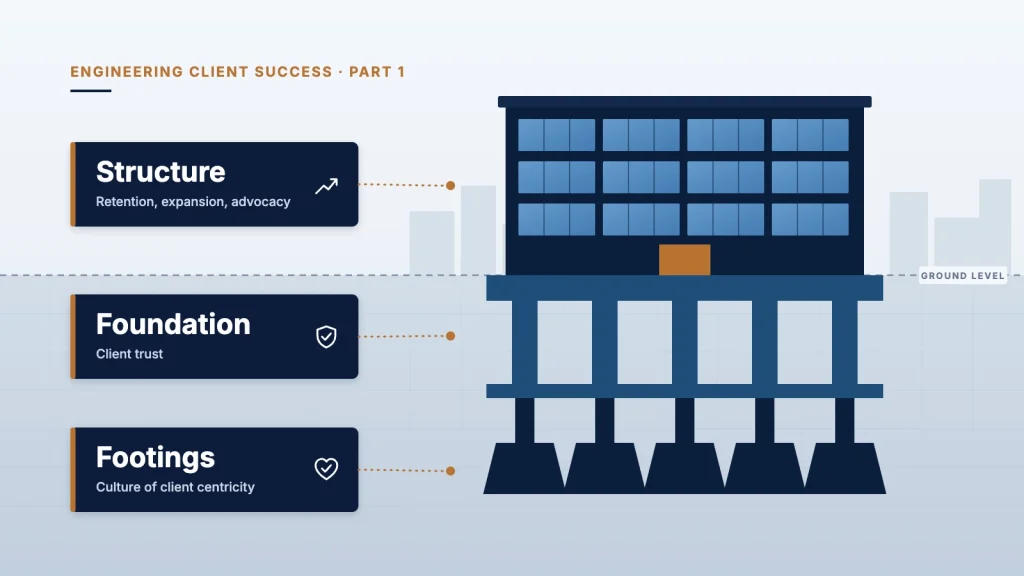
In my first article, I described footings as the client centricity base requirement. The part of the structure that sits below the surface, distributes the load, and ultimately determines whether anything above it can endure. In organizations, this is where culture lives. Not as a set of stated values but as the operating reality that shapes how work actually gets done.
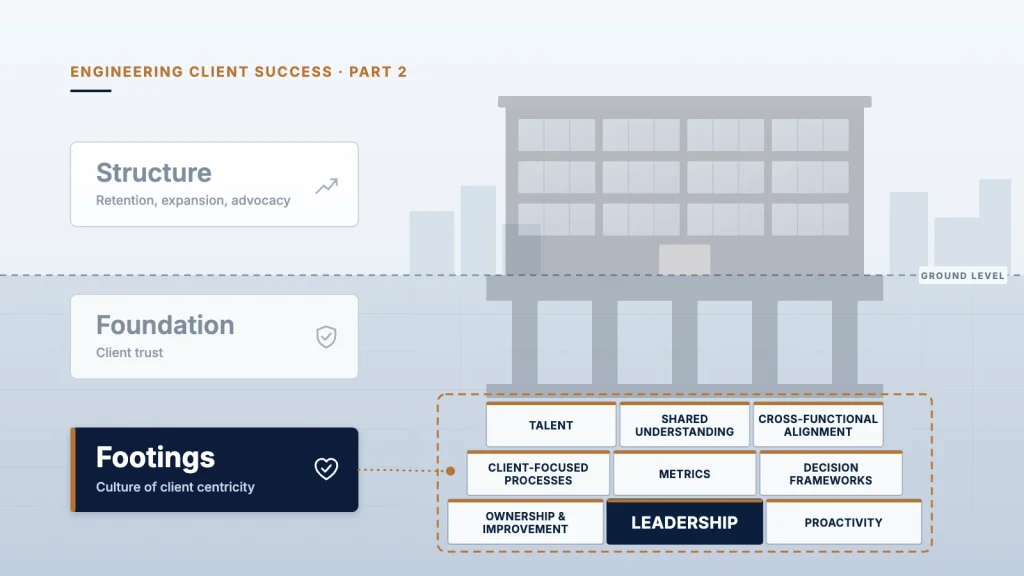
This article builds on that idea by unpacking what those footings actually consist of and how organizations can intentionally construct a culture that consistently puts the client at the center. If client centricity is the footing, the elements below are the materials and load paths that it’s composed of and together they determine whether it holds under pressure.
Client centricity does not come from belief or good intent. It comes from the systems, behaviours, and decisions that are reinforced every day, especially when trade-offs are required.
Leadership Sets the Load-Bearing Standard
One of the clearest signals of client centricity is how leadership behaves when priorities compete. Leaders set the tone not through declarations, but through what they consistently ask about, what they reward and where they intervene.
When leadership visibly considers client impact in planning discussions, reviews outcomes through a client lens and engages early when risk appears, teams learn that client outcomes are not optional. Over time, this modelling becomes cultural muscle memory rather than an exception.
Shared Understanding Enables Aligned Decisions
A client-centric culture depends on shared understanding. Organizations struggle when knowledge of the client is fragmented across teams or trapped in individual relationships.
Strong footings require a common, evolving understanding of who the client is, what success looks like from their perspective, and how those objectives change over time. When this understanding is embedded across the organization, teams can make aligned decisions without waiting for escalation or approval.
Cross-Functional Alignment Reduces Friction
Clients do not experience internal structure, they experience outcomes. That is why cross-functional alignment is a critical footing.
When teams optimize for local goals rather than shared client outcomes, friction appears in handoffs, communication breaks down, and accountability becomes blurred. Organizations that intentionally align functions around the client journey ensure ownership remains clear and the experience remains coherent.
Processes Should Follow the Client, Not the Org Chart
Client centricity often erodes when processes are built primarily for internal efficiency.
Strong footings are established when operating processes, particularly onboarding, adoption, and ongoing engagement, are designed from the client’s point of view. This does not mean ignoring efficiency. It means balancing it with clarity, consistency, and predictability, which are foundational to trust.
Talent Reinforces Culture at Scale
Culture is shaped by who an organization brings in and how those individuals are developed.
Teams that value partnership over transaction and long-term outcomes over short-term wins reinforce client centricity in subtle but powerful ways. Hiring, onboarding, and development practices that emphasize accountability, collaboration and client understanding help ensure the culture scales as the organization grows.
Metrics Signal What Truly Matters
What gets measured reinforces what matters.
Organizations that rely solely on activity metrics or lagging indicators often find themselves reacting too late. Client-centric footings are strengthened by metrics that surface leading indicators of health, adoption, and relationship strength, driving action rather than explanation.
Relationship metrics are not about sentiment for its own sake. They reflect trust, engagement depth, executive alignment, and the quality of communication. When measured deliberately, they surface risk earlier than renewal dates or revenue signals ever can.
Metrics tell teams what matters, but decision frameworks determine how trade-offs are made when those metrics compete. When teams are measured on outcomes that reflect both client value and relationship health, behaviour naturally aligns and short-term optimization gives way to durable partnership.
Decision Frameworks Prevent Quiet Erosion of Trust
Every organization faces trade-offs. The difference between fragile and resilient client relationships often comes down to how those trade-offs are evaluated.
Decision frameworks that explicitly consider client impact alongside commercial and operational factors help prevent short-term optimization from quietly eroding trust. Over time, consistency in decision-making builds credibility both internally and externally.
Ownership and Improvement Go Hand in Hand
Client-centric organizations treat ownership and improvement as inseparable.
When issues arise, the focus is not on blame but on learning and adjustment. Embedding continuous improvement into operating rhythms allows organizations to adapt without destabilizing the structure, keeping the footings strong as client needs evolve.
Proactivity Protects the Relationship Early
The most durable client relationships are protected through proactivity.
When teams are equipped with early signals, forward-looking reviews, and the capacity to act before issues escalate, surprises become rare. Built into daily workflows, proactivity shifts organizations from reacting to problems to preventing them.
Why Footings Matter
These elements are rarely visible from the outside but they determine everything that follows. Together, they form the footings where culture is made practical, shaping how decisions are made, how teams behave, and how clients are experienced over time.
When client centricity is engineered at this level, it stops being a statement of intent and becomes a structural advantage that is not dependent on individual effort or good intentions but embedded in how the organization operates.
Footings make client centricity durable.
In the next article, I will move up to the foundation, where that durability translates into client trust and long-term partnership value.