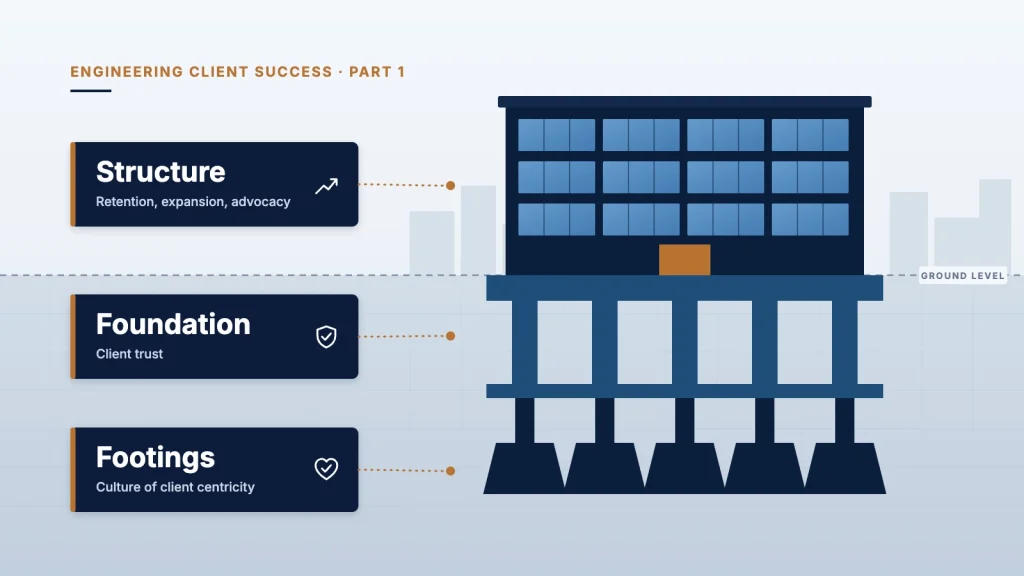
This is the fourth article in my series on engineering client success. In the first article, I introduced the idea that sustainable client success is engineered, not improvised. It is built deliberately, with structural discipline. The second article focused on the footings, the cultural and leadership behaviours that determine whether client centricity is real or situational. The third explored the foundation of trust, the combination of transactional excellence and emotional credibility that allows relationships to compound.
This article moves up the structure because once the footings are stable and the foundation is strong, something powerful happens. You stop managing accounts. You start building partnerships and measurable performance begins to compound.
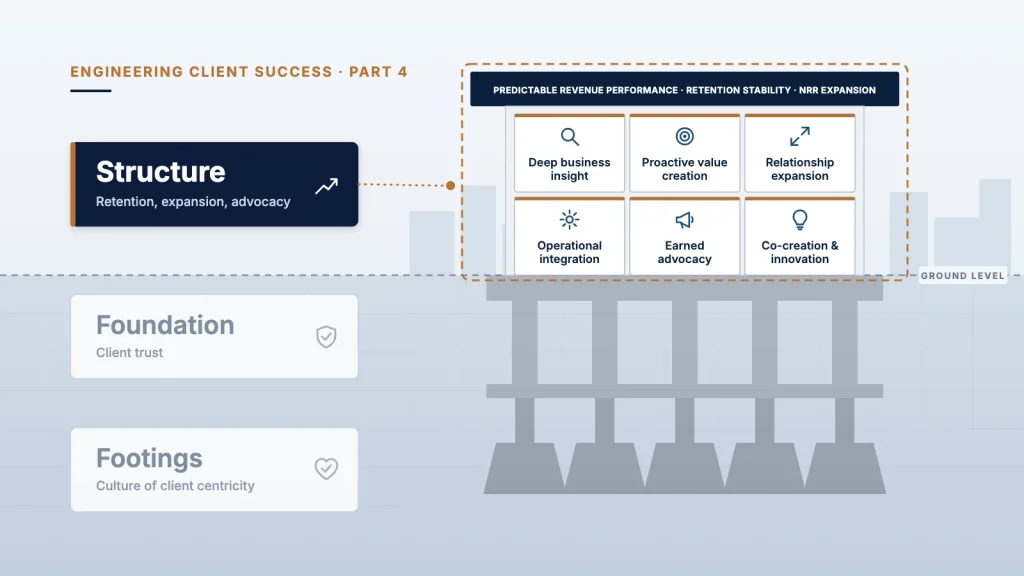
Deepening Insight Into the Client’s Business
When trust is established, conversations change. You are no longer confined to service reviews and issue resolution. You gain access to strategic context. You understand revenue drivers, margin pressure, regulatory risk, capital allocation priorities and board-level objectives.
This depth of insight directly influences retention quality. In my experience leading enterprise portfolios with eight-figure ARR exposure, renewal outcomes improve when value conversations move from product usage to business impact. Health scores become more predictive. Forecasts become more reliable. Surprises decrease.
Credibility improves visibility. Visibility improves control.
Driving Proactive Value Creation
Most organizations talk about value, few operationalize it. When the foundation is strong, you do not wait for renewal cycles to demonstrate impact. You identify performance gaps early. You surface expansion pathways before procurement initiates them. You quantify ROI before stakeholders ask for it.
Value realization is embedded into governance, executive business reviews and account planning discipline. This is where Gross Revenue Retention stabilizes and Net Revenue Retention begins to expand.
At this stage, renewals are not defensive motions. They are the continuation of a proven economic relationship.
Expanding the Relationship
Expansion is rarely the result of a well-timed pitch. It is the byproduct of demonstrated impact and institutional trust. When clients see measurable outcomes tied to strategic objectives, conversations broaden naturally. Additional business units engage. Multiyear commitments become viable. Budget reallocation becomes easier to justify.
In mature environments, expansion is not episodic. It is systematic. It is forecastable.
That predictability is a leadership outcome, not a sales tactic.
Strengthening Operational Integration
As partnerships mature, integration deepens. Governance structures formalize. Data alignment improves. Escalation paths are clearer. Joint planning cycles synchronize. Executive sponsors engage consistently.
Operational integration reduces friction and improves margin performance on both sides. It also increases switching costs, not through contractual lock-in but through embedded operational alignment.
That is a far more durable form of retention.
Earning Advocacy
Advocacy is earned. When clients experience sustained value, operational consistency and strategic partnership, they begin to speak on your behalf. They provide references. They participate in case studies. They advocate internally when budgets tighten. Advocacy accelerates pipeline velocity and lowers acquisition cost.
It is one of the most powerful, and most under-leveraged, growth multipliers in enterprise environments.
Co-Creation and Innovation
At the highest level of maturity, the relationship shifts again. You are invited into roadmap discussions. You influence prioritization. You collaborate on pilots. You shape commercial models that align incentives on both sides. Innovation becomes joint, not transactional.
This is where Customer Success moves from protecting revenue to shaping it. It is also where long-term Net Revenue Retention becomes structurally achievable.
The Structure Above the Foundation
None of these outcomes are accidental. They are not driven by personality. They are not driven by aggressive selling. They are not driven by heroics. They are structural outcomes.
When culture reinforces client centricity, when leadership demands operational discipline, and when trust is built through consistent execution, the relationship compounds economically.
This is the upper structure of engineered client success. This is where sustainable, predictable growth lives.