

What if building lasting client relationships followed the same principles that hold a well-engineered structure in place? It is a question that has shaped my career and one that connects two passions that have defined how I think about growth, resilience, and long-term value creation.
My passion for engineering started early. I have always been drawn to how things work, why they work, and how small details determine whether something holds strong or eventually fails. That curiosity still shows up today. When our clothes dryer recently stopped working, I skipped the repair call and tried fixing it myself. I took it apart, tracked down the issue, swapped the broken parts, and put it back together. It worked like new. The experience was a simple reminder of how much I enjoy breaking systems down, understanding them fully, and rebuilding them to be stronger than before.
Before going further, I want to be clear that I am not identifying myself as an engineer, nor am I minimizing the training or expertise required in that profession. My use of engineering concepts comes from respect and appreciation, not credential.
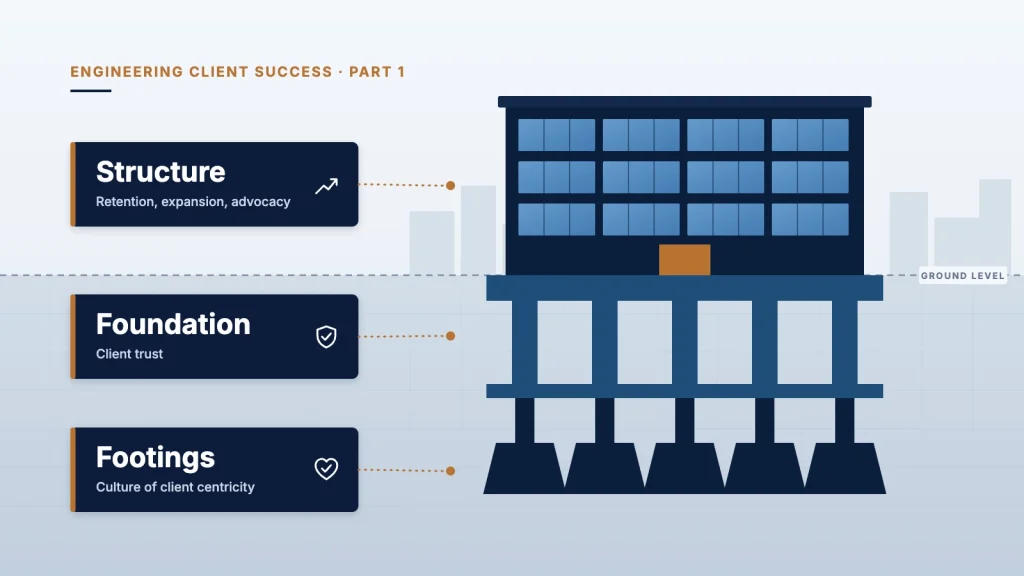
As my career evolved, I realized something important. The same mindset that guides structural engineering also guides organizations that excel at client success. Both require discipline, sequencing, and a willingness to invest below the surface before expecting results above it. Strong footings, a reliable foundation, and a well-designed structure create stability, trust, and the conditions for sustainable growth.
Footings: The Client Centricity Base Requirement
Every resilient structure begins with solid footings. They distribute weight, protect against shifting ground, and create the stability needed for everything that follows. In organizations, footings represent a genuine commitment to client centricity. Without them, nothing above the surface will stand for long.
Footings show up in everyday choices. How teams prioritize work. How they communicate internally and externally. How they think about clients even when the client is not in the room. Strong footings are built through operating rhythms that favour proactive engagement over reactive response, long-term outcomes over short-term convenience, and behaviours that treat client centricity as a way of working rather than a stated value. When footings are secure, the structure above is free to grow higher and stronger.
Foundation: Where Trust Takes Shape
Once footings are secure, the foundation is built. This is what carries the structure, ties every element together, and resists pressure as conditions change. Client trust is the foundation that determines how much weight a relationship can support and how far it can grow.
Trust is created day by day and action by action. Organizations build it when they deliver on promises, meet service levels, and follow through with consistency. Trust deepens when teams solve problems before clients need to ask and when they avoid shortcuts that may save time in the moment but introduce risk over time.
The foundation also includes the way clients experience the journey. When processes are smooth, predictable, and efficient, clients feel supported rather than managed. Operational excellence becomes more than an internal measure, it becomes part of the client experience. A strong foundation sends a clear message. The client’s success matters, and the organization can be counted on to support it, even as expectations and complexity increase.
The Structure: The Visible Proof of Partnership and Growth
As people look at the structure, they see success, even though its stability comes from what they cannot see. In client success, the structure represents partnership, shared value, and growth that feels earned rather than forced.
Each layer of the structure reflects intentional work. Co-creation and innovation. Advocacy built through results. Operational integration that reduces friction. Deeper understanding of the client’s business. Proactive value creation that anticipates what comes next. The height and durability of this structure are ultimately limited by how much trust the foundation can carry.
When these elements align, clients begin to view the relationship as essential to their own growth. They champion the impact, welcome deeper collaboration, and see expansion as a natural step forward. Growth feels organic because it is supported by the right elements, placed with purpose, on footings designed to last.
The structure stands tall because every layer reinforces the one beneath it.
Closing Reflection
Engineering taught me that what happens below the surface determines what is possible above it. Client success works the same way. Organizations that invest in client-centric footings, build a foundation of trust, and intentionally strengthen the structure through partnership are better equipped to retain, expand, and grow through change.
The leadership question is straightforward. Is your organization over-invested in what clients can see, and under-invested in what actually holds everything together?
In future posts, I will break down the specific elements within the footings, foundation, and structure that make up a scalable client success model.
About the Author
Marco Angelone is a senior client success and growth leader with deep experience across fintech, loyalty, and SaaS. He specializes in designing and scaling client success organizations, strengthening executive partnerships, and building the operating frameworks that drive retention, expansion, and long-term enterprise value.
Across his career, Marco has led global portfolios exceeding $80M in revenue, advised executive teams on customer strategy and governance, and built high-performing teams that connect customer outcomes to sustainable growth. His work sits at the intersection of strategy, operations, and relationship management, with a practical focus on turning trust and execution into measurable results.