

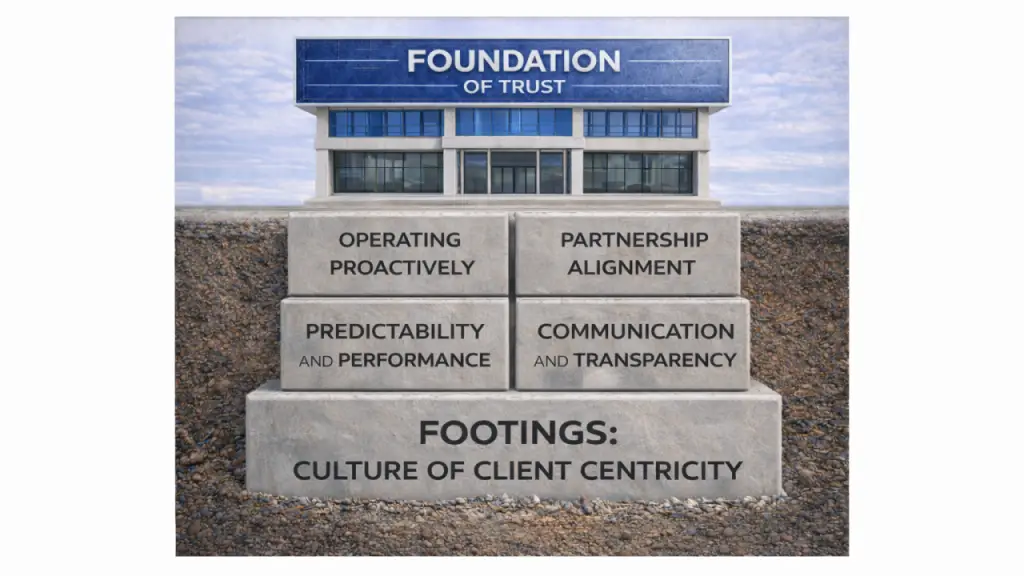
This is the third article in a series on engineering client success. Throughout the series, I have explored the idea that sustainable client success is engineered, not improvised. In the first article, I introduced the principle that it must be built deliberately, from the ground up, using the same structural discipline that applies to any durable system. The second examined the footings, the cultural and leadership behaviours that determine whether client centricity is real or situational.

If the footings are about intent and behaviour, the foundation is about trust. Like any foundation, it is largely invisible once the structure is standing but absolutely determines whether anything built on top of it will hold.
Trust is often treated as a soft concept in Customer Success. In reality, it is one of the most structural elements in the entire operating model. Trust enables predictability, allows performance to compound, and gives customers the confidence to invest deeper over time. Without it, even strong delivery metrics become fragile.
The mistake many organizations make is treating trust as a by-product of good outcomes. In practice, trust is a prerequisite for sustained outcomes.
Predictability and Performance
One of the strongest signals of trust is predictability.
Customers do not expect perfection but they do expect consistency. Predictable delivery, predictable communication and predictable decision making allow customers to plan, commit resources and take risks alongside you. When performance is erratic, even if outcomes are occasionally strong, confidence erodes.
Predictability comes from disciplined operating rhythms. Clear commitments, realistic timelines, and consistent follow through matter more than heroic efforts or last minute recoveries. Customers trust partners who do what they say they will do, when they say they will do it and who raise their hand early when something is at risk.
Performance reinforces trust when it is repeatable. One strong quarter does not create confidence. A pattern of execution does. Over time, predictability becomes a form of performance in itself.
Communication and Transparency
Trust is built through what is said and what is shared.
Customers assess trustworthiness not only by outcomes but by how information flows. Are they hearing about issues early, or only once impact is unavoidable? Are trade offs explained clearly, or hidden behind process and internal constraints? Is communication tailored to what actually matters to them, rather than what is convenient for the provider to report?
Transparency is not about oversharing. It is about relevance and honesty. Customers value partners who communicate with clarity, who explain decisions in context and who are willing to say no when something is not in the customer’s best interest.
Importantly, transparency must exist in both directions. Strong foundations are built when customers feel safe sharing real constraints, internal pressure, and political realities. That only happens when they believe the information will be used responsibly, not commercially weaponized.
Partnership Alignment
Trust strengthens when alignment is explicit rather than assumed.
Many relationships fail not because of poor intent but because expectations drift. Objectives change. Leadership changes. Constraints change. Without deliberate alignment, partnerships slowly become misaligned even when both sides believe they are acting reasonably.
Aligned partnerships are anchored in shared outcomes, not just contractual deliverables. They require clarity on what success actually looks like, how it will be measured, and how decisions will be made when priorities conflict.
Trust grows when customers see that alignment is actively maintained. Regular executive engagement, clear governance, and open recalibration conversations signal that the relationship is being stewarded, not left on autopilot.
When alignment breaks down, trust follows quickly. When alignment is reinforced, even difficult conversations become constructive rather than adversarial.
Operating Proactively
Perhaps the most under-appreciated element of trust is proactivity.
Customers trust partners who are thinking ahead on their behalf. Proactivity shows up as early risk identification, thoughtful recommendations before issues arise and a willingness to surface uncomfortable truths before they become unavoidable.
Reactive organizations force customers into constant escalation mode. Proactive organizations reduce noise by addressing problems before customers feel them.
This requires more than good intentions. It requires systems that surface leading indicators, teams empowered to act before approval chains stall progress and leadership that supports early intervention even when the issue is not yet visible on a dashboard.
Proactivity tells customers that they are not alone in managing complexity. That signal alone often does more to build trust than any single outcome.
Trust as a Load Bearing Element
When predictability, transparency, alignment, and proactivity are present, trust becomes load bearing.
It carries the weight of growth, change and complexity. Customers are more willing to explore new use cases, engage at the executive level and commit to longer term partnerships. Conversations become collaborative rather than defensive. Change feels manageable rather than risky.
Without this foundation, growth becomes brittle. Expansion requires pressure. Renewals require justification. Every change feels like a renegotiation of trust.
This is why trust cannot be delegated or assumed. It must be designed, reinforced and protected intentionally.
Foundation Before Structure
Footings determine whether client centricity is real. The foundation determines whether trust is durable. Only then does the structure, the visible growth, partnerships and outcomes, stand a chance of lasting.
In the next article, I will explore the structure itself, how strong foundations enable not just retention but resilient, compounding growth over time.
Because in client success, as in engineering, what you build on top is only as strong as what you build underneath it.