

We’ve overcomplicated Client Success. Loyalty programs solved this years ago.
Hi, I’m Marco Angelone. For over 20 years, I’ve engineered and scaled Client Success for enterprise and high-growth fintech and SaaS companies, helping drive retention, expansion and predictable revenue growth. My broader career sits at the intersection of financial services and loyalty, shaped by early experience in transaction-based and membership-driven business models. That foundation gives me a unique perspective on how transaction economics and long-term client relationships drive growth. It’s grounded in a marketing background and shaped by experience across both B2C and B2B environments.
This is what loyalty taught me, shaping how I think about Client Success.
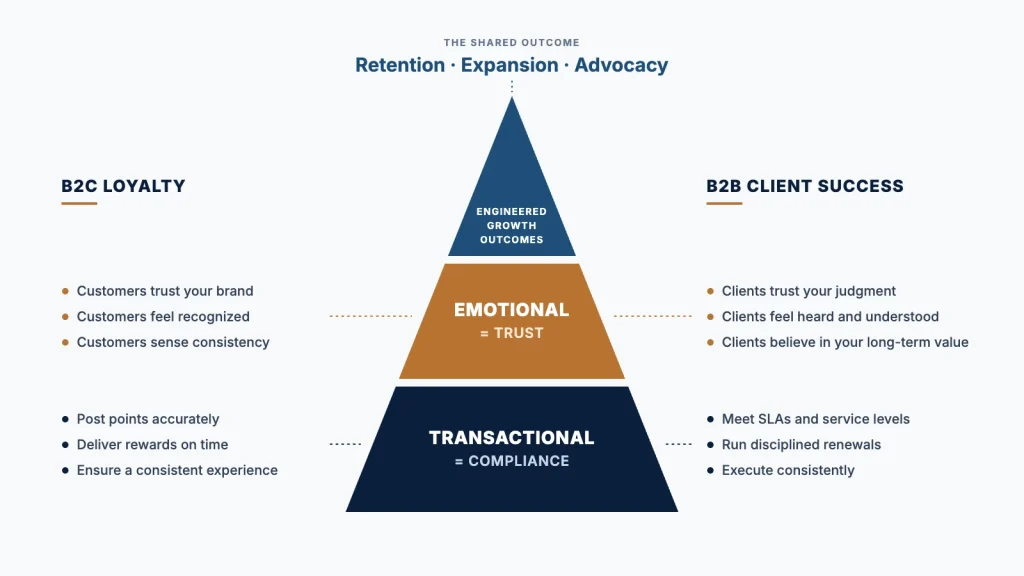
Loyalty isn’t built on points, it’s built on behaviour. Behaviour comes down to two things: the transactional and the emotional.
In loyalty programs, these two forces are already designed to work together. The transaction creates consistency. The emotional connection creates preference. Together, they drive repeat behaviour, retention and growth. Client Success is trying to achieve the same outcome. It just doesn’t always treat it as a system.
Most organizations over-rotate on transactional behaviour. Do what you said you would do. Deliver consistently. Make the numbers work.
In B2C, that means points post correctly, rewards show up on time, the experience is reliable. In B2B, it’s no different. You meet commitments, hit service levels, run a clean operation, bring discipline to renewals.
This is the baseline. It’s the footing. Without it, nothing else holds. Here’s the issue.
Transactional behaviour doesn’t create loyalty, it creates compliance.
Customers stay out of convenience, not because they trust you.
Emotional behaviour is what actually drives outcomes.
In B2C, it’s the feeling a customer has toward a brand: trust, recognition, consistency. It’s why they come back, even when alternatives exist.
In B2B, the same dynamic plays out. Clients stay, expand and advocate when they trust your judgment, feel heard, see consistent value and believe you are looking out for their long-term outcomes.
This is where most teams underinvest.
This is where the foundation is built, something I’ve written about in my other posts. Engineering Client Success, Engineering Client Success: The Foundation of Trust
It shows up in the moments that matter most. When something breaks. When priorities shift. When conversations get uncomfortable.
This is where loyalty is actually built. This is where growth comes from.
Strong Client Success isn’t about choosing one or the other. It’s about being intentional about both.
Transactional rigor creates stability. Emotional trust creates expansion.
Get both right, you create the structure that makes retention predictable and growth compounding.
Miss one. Everything becomes harder than it needs to be.
This is what loyalty taught me. It remains central to how I think about building Client Success today.
Thoughts?
I welcome connecting and hearing how others are thinking about Client Success through the lens of loyalty. I am open to conversations on building stronger client relationships and more predictable growth. I partner with organizations to engineer more effective Client Success models through advisory, team coaching, speaking engagements, or full-time leadership roles.